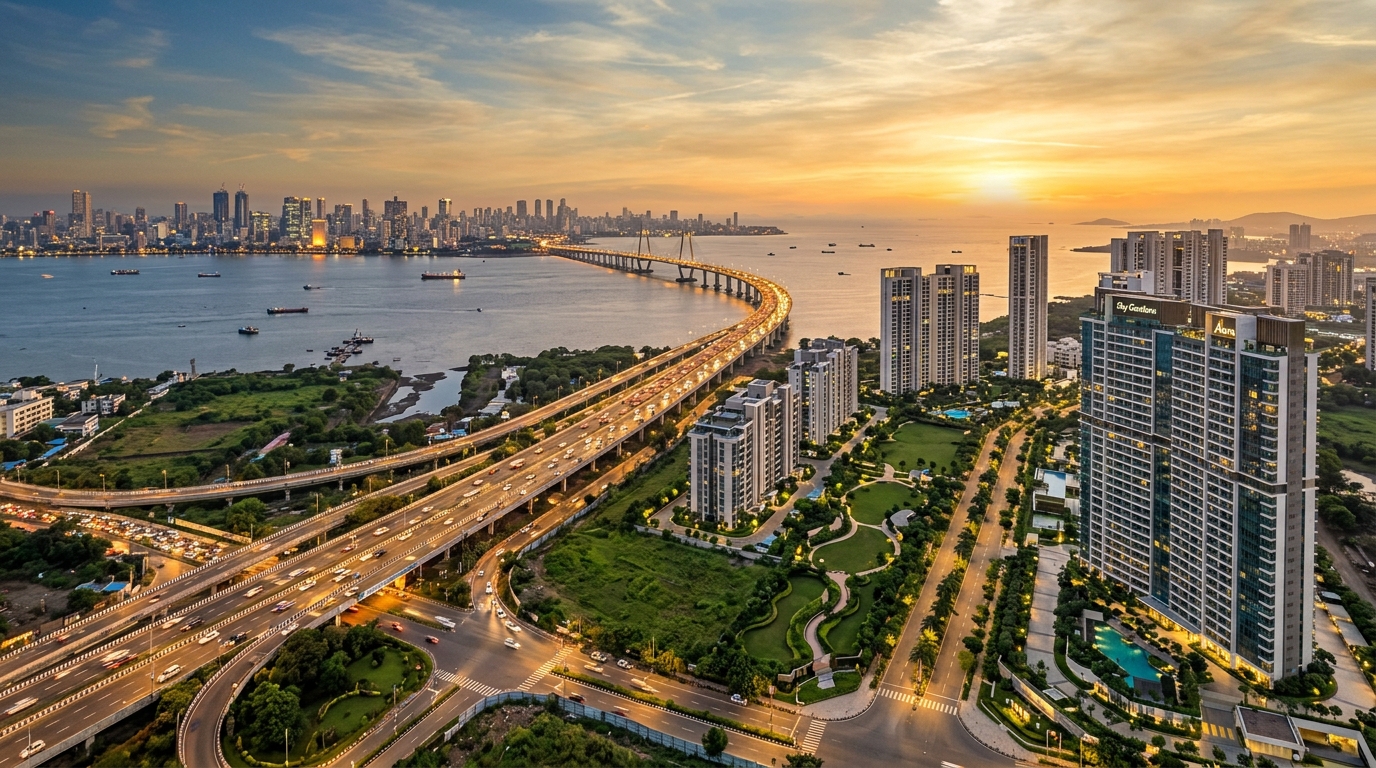
The Mumbai Metropolitan Region (MMR) represents India's most resilient and commercially dynamic real estate market. Historically perceived as an ultra-expensive island city dominated by South and Central Mumbai high-rises, the region’s investment landscape has fundamentally transformed.
A massive wave of transformative infrastructure—including the Mumbai Trans Harbour Link (Atal Setu), expansive metro corridors, the Panvel–Karjat suburban rail expansion, and the Navi Mumbai International Airport (NMIA)—has reshaped capital flow. Today, property investment in MMR offers diverse opportunities: from established commercial belts with stable rental yields to high-velocity emerging corridors offering exponential capital appreciation on land and plotted developments.
Why Invest in Mumbai?
Investing in the Mumbai real estate ecosystem offers distinct financial advantages unmatched by any other Indian metropolitan region:
- Unstoppable Economic Magnetism: As India’s financial and commercial capital, Mumbai generates substantial corporate, financial, and industrial employment, driving continuous demand for residential and commercial spaces.
- Transformative Connectivity Upgrades: Multi-billion dollar infrastructure projects have drastically compressed travel times between core city centers and peripheral growth corridors, driving land value appreciation across outer suburban nodes.
- High Liquidity and Demand: Mumbai consistently commands the lowest vacancy rates in urban India, ensuring that quality assets retain resale liquidity and steady rental absorption.
- Tiered Entry Points: While prime island city properties require significant capital, the wider MMR offers accessible entry points for mid-segment housing, luxury second homes, and high-ROI Non-Agricultural (NA) plots.
12 Top Areas to Invest in Mumbai Real Estate
1. Karjat
Karjat has rapidly evolved from a scenic weekend getaway into one of MMR’s most lucrative real estate investment hotspots. Positioned strategically at the intersection of Mumbai, Navi Mumbai, and Pune, Karjat offers what core urban centers cannot: affordable land, expansive open spaces, and rapid capital appreciation.
- Primary Asset Types: Non-Agricultural (NA) sanctioned plots, gated farmhouse communities, luxury villas, and affordable residential townships.
- Key Growth Drivers: The doubling of the Panvel–Karjat suburban railway line, direct connectivity to the upcoming Navi Mumbai International Airport via State Highway 54, and seamless transit through the Mumbai Trans Harbour Link (Atal Setu).
- Investment Potential: High capital appreciation driven by rising demand for plotted land, second homes, eco-resorts, and hybrid-work residential retreats. Explore our detailed guide to NA Land in Karjat for legal zoning and verification steps.
2. Thane (Ghodbunder Road & Majiwada)
Thane operates as an independent economic powerhouse featuring self-contained commercial hubs, premium social infrastructure, and expansive residential townships.
- Primary Asset Types: 2 BHK & 3 BHK high-rise apartments and luxury residential enclaves.
- Key Growth Drivers: Metro Line 4 (Wadala–Kasarvadavali), the proposed Thane-Borivali twin tunnel, and established corporate IT parks.
- Investment Potential: Ideal for steady, risk-averse investors seeking predictable rental yields (3% to 4%) and strong end-user secondary market liquidity.
3. Panvel
As the gateway to Navi Mumbai, Panvel has transformed into a high-density multimodal transport and residential nucleus.
- Primary Asset Types: Mid-segment apartments, integrated smart city townships, and commercial spaces.
- Key Growth Drivers: Proximity to the Navi Mumbai International Airport, the Sion-Panvel Expressway, and the terminal expansion for outstation rail networks.
- Investment Potential: Strong mid-to-long-term capital appreciation driven by airport-adjacent commercial demand.
4. Chembur
Chembur provides unmatched geographic positioning, connecting South Mumbai, Central Suburbs, and the commercial business district of Bandra-Kurla Complex (BKC).
- Primary Asset Types: Redevelopment luxury towers and premium 2 to 4 BHK apartments.
- Key Growth Drivers: Eastern Freeway, BKC-Chembur Link Road, and the Santacruz-Chembur Link Road (SCLR).
- Investment Potential: Premium rental returns fueled by senior corporate professionals working in BKC and Lower Parel.
5. Malad – Goregaon
The Western Suburbs’ primary corporate corridor features premier IT parks, television production studios, and commercial retail hubs.
- Primary Asset Types: 1 BHK to 3 BHK modern apartments in gated high-rises.
- Key Growth Drivers: Metro Line 2A and Line 7, Western Express Highway, and commercial employment hubs like Mindspace and Nesco.
- Investment Potential: Strong, continuous rental demand with zero vacancy turnaround for well-located societies.
6. Andheri (East & West)
Andheri remains Mumbai’s central urban crossroad, balancing high-density business districts in the East with premium media and lifestyle belts in the West.
- Primary Asset Types: Commercial office suites, studio apartments, and premium condominiums.
- Key Growth Drivers: Metro Line 1 & Line 7 convergence, Chhatrapati Shivaji Maharaj International Airport, and major rail transit.
- Investment Potential: Exceptional liquidity and above-average rental yields for compact urban units.
7. Ulwe
Ulwe is a meticulously planned node in Navi Mumbai, designed by CIDCO with modern urban road grids and coastal transit access.
- Primary Asset Types: 1 BHK & 2 BHK modern apartment buildings.
- Key Growth Drivers: Direct access from the Atal Setu landing point, proximity to the new airport, and the operational Nerul-Uran railway corridor.
- Investment Potential: High capital gains for early-to-mid-stage investors as regional commercial operations ramp up.
8. Dombivli – Kalyan
Representing the core of MMR's affordable to mid-income housing market, Dombivli and Kalyan feature massive self-contained townships with integrated social amenities.
- Primary Asset Types: Budget 1 BHK and 2 BHK apartments in mega-townships.
- Key Growth Drivers: Kalyan-Taloja Metro Line 12, the Airoli-Katai Tunnel Road, and expanded civic infrastructure.
- Investment Potential: Steady value appreciation coupled with high rental demand from middle-income industrial and service-sector workforces.
9. Wadala
Strategically positioned as an extension of the Island City, Wadala is evolving into an integrated commercial and residential district often termed "BKC-2."
- Primary Asset Types: Ultra-luxury high-rises and integrated corporate complexes.
- Key Growth Drivers: Monorail, Eastern Freeway, upcoming Metro Line 4, and large-scale redevelopment of former mill and port land.
- Investment Potential: Significant long-term upside for high-net-worth investors betting on central urban consolidation.
10. Kanjurmarg – Powai
Powai's tech-driven startup and financial ecosystem has expanded outward, turning Kanjurmarg into a central suburban residential hub.
- Primary Asset Types: Premium 2 BHK and 3 BHK township apartments.
- Key Growth Drivers: Jogeshwari-Vikhroli Link Road (JVLR), Central Railway mainline, and Metro Line 6.
- Investment Potential: High-income tenant demographic supporting healthy rental yields and strong capital value retention.
11. Mira Road
Mira Road provides an accessible gateway along the Western suburban corridor, appealing to young professionals and growing families.
- Primary Asset Types: Budget and mid-range residential high-rises.
- Key Growth Drivers: Ongoing Metro Line 9 expansion, widening of the Ghodbunder link, and extensive commercial retail expansion.
- Investment Potential: Consistent rental occupancy paired with entry-level property ticket sizes.
12. Neral – Vangani Belt
Situated directly adjacent to Karjat along the Central suburban line, the Neral-Vangani pocket caters to entry-level homebuyers and budget-conscious land investors. Compare entry options in our guide on Karjat vs Neral Real Estate.
- Primary Asset Types: Low-budget apartments, small NA plots, and affordable holiday homes.
- Key Growth Drivers: Overflow growth from Karjat’s infrastructural expansion, local suburban rail connectivity, and scenic, green foothills.
- Investment Potential: Low capital commitment with substantial percentage-based upside over a 5 to 7-year horizon.
How to Pick the Right Location for Investment in Mumbai?
Navigating MMR’s diverse property market requires assessing specific performance metrics:
- Verify Infrastructure Delivery Timelines: Invest where transit infrastructure is either under active construction or newly operational. Transit access is the single largest driver of MMR property appreciation.
- Prioritize RERA Compliance and Clear Titles: Always confirm MahaRERA registration for under-construction projects. For plotted land developments in locations like Karjat, ensure the land holds definitive Collector-sanctioned Non-Agricultural (NA) status with clear title deeds. Read our step-by-step guide on verifying land records in Maharashtra.
- Align Asset Class with Investment Goals: For immediate rental returns, prioritize established micro-markets like Andheri or Thane. For exponential capital multipliers, allocate capital to land and plotted corridors along upcoming transit axes.
- Evaluate Developer Execution Track Record: Choose developers with a demonstrated history of timely delivery, transparent documentation, and well-maintained projects.
Real Estate Investment Options in Mumbai
Flats / Apartments
Flats are the standard investment vehicle across Mumbai's urban sprawl.
- Best Suited For: Passive investors seeking quarterly rental returns and capital preservation.
- Pros: Steady tenant demand, simple property management, clear municipal utility access.
- Cons: High entry cost, recurring maintenance charges, and capital depreciation on the building structure after 20–25 years.
NA Land / Plots
Sanctioned Non-Agricultural (NA) plots in peripheral corridors such as Karjat, Neral, and Panvel are an increasingly preferred asset class for wealth creation.
- Best Suited For: Investors seeking high capital appreciation with zero building-depreciation drag.
- Pros: 100% freehold land ownership, lower initial entry ticket, zero maintenance costs, and maximum upside flexibility (build later or sell as raw land).
- Cons: Requires diligent verification of land zoning, FSI sanctions, and road access. Check out our analysis on Bungalow vs NA Plot vs Farmhouse.
Tenements / Bungalows & Villas
With shifting lifestyle preferences toward wellness and hybrid work, gated villa communities and independent bungalows in green corridors have surged in popularity.
- Best Suited For: High-net-worth investors seeking dual-purpose utility—a weekend retreat with holiday rental income (via Airbnb or private hospitality operators).
- Pros: Private open space, personal lifestyle use, and dual monetization through seasonal short-term rentals. Explore top option reviews in 7 Best Villas in Karjat with Pool.
- Cons: Higher initial acquisition and ongoing landscaping maintenance costs.
Mumbai Real Estate High-Growth Locations
To structure a real estate portfolio across MMR, categorize micro-markets by their current development phase:
-
Tier 1: Established Value (Defensive Capital Preservation)
Locations: Andheri, Chembur, Powai, Malad.
Profile: High liquidity, established commercial infrastructure, reliable rental flow, stable single-digit annual appreciation. -
Tier 2: Infrastructure Catalysts (Balanced Growth & Yield)
Locations: Thane, Panvel, Wadala.
Profile: Supported by mega-projects like metro lines and new business hubs; balanced capital appreciation with solid tenancy. -
Tier 3: High-Velocity Growth Corridors (Maximum Capital Multipliers)
Locations: Karjat, Ulwe, Neral, Dombivli East.
Profile: Transforming from fringe zones to mainstream hubs via transit corridors (Atal Setu, Panvel–Karjat rail, NMIA); highest projected percentage gains on land and plotted developments over 5–10 years. For details on upcoming master plans, view the Karjat Development Plan 2036.
FAQs
How much capital is required to start investing in Mumbai real estate?
Investment thresholds depend on the asset class and location. While buying a 1 BHK flat in Mumbai's western or central suburbs typically requires Rs. 60 Lakhs to Rs. 1.2 Crore, investing in a legally clear, Collector-approved NA plot in emerging corridors like Karjat starts between Rs. 15 Lakhs to Rs. 35 Lakhs.
Where can I find the highest rental yield in Mumbai and MMR?
The highest residential rental yields in Mumbai (often between 3.5% and 5%) are found in commercial adjacent hubs like Andheri East, Kanjurmarg, and Powai. In peripheral lifestyle belts like Karjat, furnished villas and managed farmhouses operating as short-term holiday rentals can generate gross yields exceeding 6% to 8% through weekend tourism.
Why is Karjat becoming a preferred choice for Mumbai property investors?
Karjat combines lower per-square-foot entry pricing with rapid infrastructural transformation. The doubling of the suburban railway from Panvel to Karjat, fast access to the new Navi Mumbai International Airport, and proximity to both Mumbai and Pune have accelerated plotted land demand, luxury villa living, and second-home tourism. Read more about why build a second home in Karjat.
Is it better to invest in an under-construction project or ready-to-move property in Mumbai?
Under-construction properties registered under MahaRERA offer lower acquisition pricing and flexible payment plans, yielding higher percentage returns upon delivery. Ready-to-move properties eliminate construction risk and allow immediate rental income, making them better for cash-flow-focused buyers.
Are NA plotted developments safer than standalone agricultural land in MMR?
Yes. Sanctioned Non-Agricultural (NA) land (such as Residential NA or Collector NA) comes with legal approvals for construction, clear demarcations, and recognized road access. Agricultural land in Maharashtra has strict ownership eligibility rules (the buyer must be a recognized farmer) and involves complex zoning permissions to build or develop.
Summary: Where to Invest in Mumbai?
Selecting the best place to invest across Mumbai and the broader MMR depends on your investment thesis.
For steady rental income and liquid asset stability, urban suburban centers like Thane, Chembur, and Andheri offer dependable fundamentals with strong corporate tenancy. For investors targeting value creation adjacent to new infrastructure megaprojects, Panvel and Ulwe provide direct upside from the Navi Mumbai International Airport and Atal Setu.
If your objective is maximizing capital appreciation on land, securing freehold ownership, or building a high-yield holiday home, emerging green corridors like Karjat stand out as the smartest move. With major transit expansions bringing Karjat closer to Mumbai's primary business hubs, investing in clear-title NA plots and gated villa communities offers the ideal balance of affordability, lifestyle appeal, and long-term capital growth.